3/1/26 Update - Spring?!
Winter Hit Hard. Here’s Where We Stand.
I haven’t posted since 1/23/26 — and that wasn’t by accident.
The last month has been brutal. Three cold snaps. Multiple stretches where temps sat in the teens for days. And then a storm that dumped roughly 14 inches of snow on us. That’s not a dusting. That’s “what state are we in?” level snow for the Outer Banks.
The hives were wrapped as tight as I could reasonably make them. Construction insulation. Five hay bales apiece. Wind breaks. Reduced entrances. They looked like little fortified bunkers.
And still — winter collected its tax with a total of 3 hives.
Hive 3
We lost Hive 3.
Inspection told the whole story immediately.
Bees with their heads in the comb. Cluster split into two separate pockets. Honey still present on frames — but not where the bees were. They had separated from their stores and couldn’t bridge the gap.
It wasn’t mites, It wasn’t moisture, It wasn’t disease, It was cold.
When temps stay low for extended periods, the cluster has to stay intact and move slowly across frames together. Once they fragment, they lose thermal mass. Once they lose mass, they lose mobility. Once they lose mobility, they lose the ability to reach food.
A few inches might as well be a mile at 15°F.
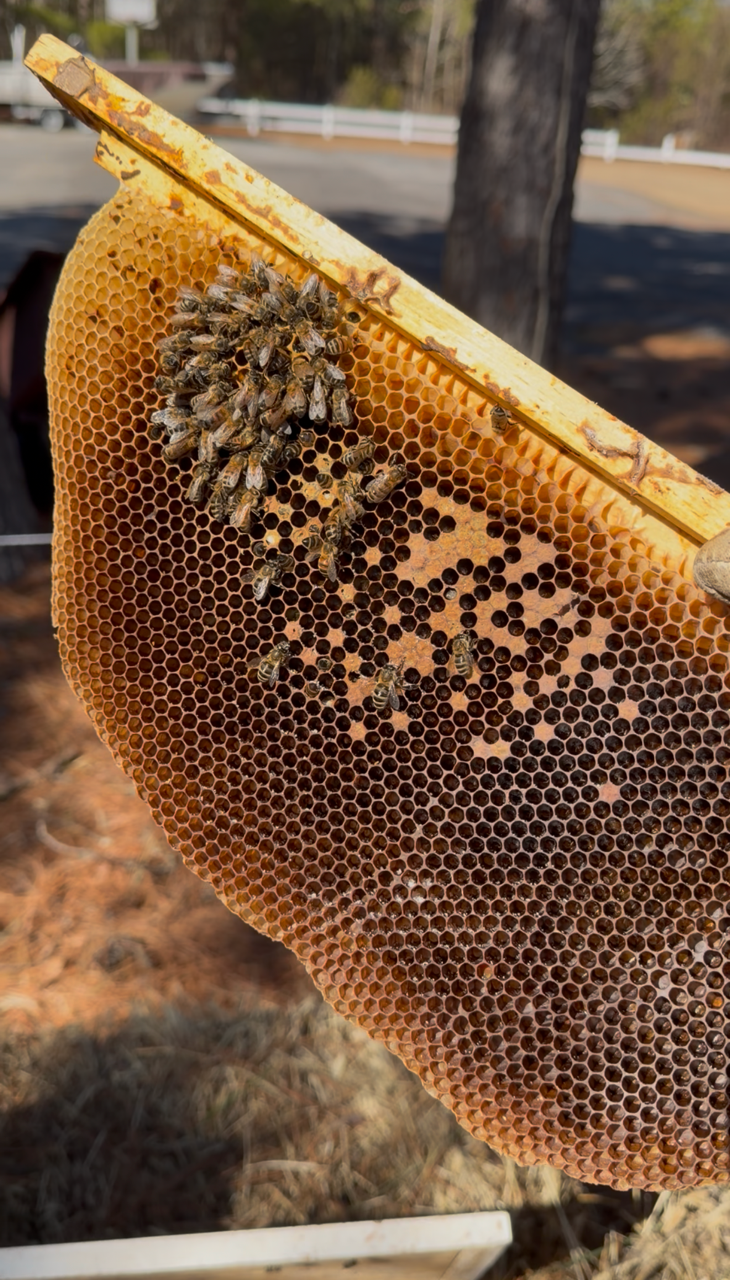
Hive 2 — Still Ornery. Still Alive.
Hive 2 is exactly what Hive 2 has always been — strong and slightly irritated about everything.
Numbers look good. Population is solid.
They burned through about 90% of the sugar we added last month. When we inspected, they had fully moved up into the super and were critically low on stores. No drama — just hungry.
We added two frames of honey directly into the brood area to keep them stable.
They’re our strongest colony right now and also the first hive fully running on the HiveLink stack.
Hive 4 — Stable but Lean
Hive 4 also came through with decent numbers, but they were cutting it close on food.
Because they’re the weaker of the two remaining hives, we gave them 2.5 frames of honey and removed the internal feeder. The goal is to simplify the box and let them consolidate around real stores instead of relying on supplemental feed.
They’re not booming, They’re not collapsing, They’re in that late-winter holding pattern with signs of a laying queen!
HiveLink — This Is the Part I’m Excited About
This is where things get interesting.
After a lot of tuning, calibration, and frustration — the HiveLink scale is finally dialed in and operational.
Each hive will be getting its own HiveLink sensor stack:
- Weight tracking
- Temperature probes in both brood chambers (top and bottom)
- Continuous logging
- Remote dashboard access
Hive 2 is currently live and reporting weight.
You can see the dashboard here:
https://thehive.sandyhillsinfosec.com/public-dashboards/2eb96ce030614eb9ad0f777c02f1839b
This changes how we manage winter.
Instead of guessing:
- We can see when stores are dropping too fast.
- We can detect brood ramp-up via temperature stabilization.
- We can see nectar flow before I visually confirm it.
- I’ll be able to catch swarm prep via weight spikes.
For a project that started as “let’s throw a temperature probe in a hive” this is a big step forward.
Where We Sit Right Now
- Hive 3: Lost to cold separation.
- Hive 2: Strong, ornery, hungry, stabilized.
- Hive 4: Stable but lean, reinforced.
Winter exposed weaknesses. It also validated the insulation strategy — because the other two made it through the same conditions.
Beekeeping isn’t romantic in February. It’s math, food stores, cluster physics, and weather. Spring isn’t here yet, But when it shows up — we’ll see it in the data first.